
 Ferrara Film Festival 2023
Ferrara
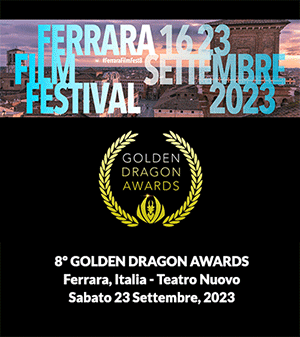
- Ferrara Film Festival 8 , 16-23 September 2023
- The Ferrara Film Festival’s awards are called the Golden Dragons, recalling the legend of the dragon slain by Saint George, the patron saint of Ferrara. For each edition of the Ferrara Film Festival, 6 members are chosen for the Giuria Principale and a further 3 panels to select the winners across all categories. The Giuria Principale judges feature films and documentaries, while the other 3 juries (“UNICEF”, “WESHORT” and “FEDIC”) are assigned respectively to the UNICEF category and to all short-film categories. In addition, the Golden Dragon lifetime-achievement awards are dedicated and presented to leading figures of the film industry.
FILM CATEGORIES EXPLAINED
Both feature-length and short films of a more commercial nature are placed in the category called Premiere Event, those of a more auteur-driven nature in the category called Premiere Autore, and documentaries fall under the Premiere Docu category. Films connected with UNICEF’s themes, UNICEF being an official festival partner, form part of the Premiere Unicef category. Finally, the category for promoting works produced in Emilia-Romagna is called Premiere Emilia-Romagna. Screenings that are part of a programme of special retrospectives fall under the Premiere Retro category.
The Ferrara Film Festival draws on prestigious partners such as the Comune di Ferrara, ASCOM, UNICEF Italia and the US Embassy in Italy. Another key element tied to the city of Ferrara is its partnership with Giovanni e Vittorio Alliata di Montereale and the Archivio Vittorio Cini.

 Effetto Venezia
Livorno
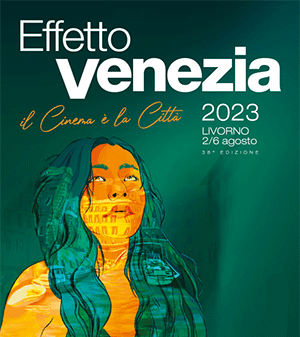
- Effetto Venezia. Il Cinema e la Città. 2-6 August 2023
- Palazzo Huigens, Wednesday 2 August 2023, 10.00pm
RAPSODIA SATANICA by Nino Oxilia
Italy, 1917, music by Pietro Mascagni -
“Rapsodia satanica” is the title of the film, screened on 2 August and made up of a prologue and two parts. It is a 1917 silent work, masterfully directed by Nino Oxilia, starring the leading Italian screen diva of the period, Lyda Borelli, with music by the Livorno-born composer Pietro Mascagni. A gem of Italian cinema, restored and shown once again to an audience that turned out in great numbers to see it.
The story is drawn from a 1915 poem by Fausto Maria Martini and echoes Goethe’s “Faust”. It tells of an elderly society lady, Alba d’Oltrevita (Lyda Borelli), who strikes a pact with Mephisto to regain her youth, on condition that she never fall in love. Alba is courted, however, by two young brothers, Tristano and Sergio. The latter threatens to take his own life if she will not love him. Alba does not return Sergio’s passion, and he takes his own life, while she prepares to marry Tristano. Having broken the terms of the pact, Alba sees Mephisto return to reclaim the youth he granted her, and she instantly turns old and dies.
The film is one of rare beauty, among the most celebrated of its period, drawing on both a markedly D’Annunzian inspiration and Futurist experimentation — two aesthetic and formal tendencies that are, in theory, incompatible and at odds, yet which Oxilia manages to bring together seamlessly.
If the subject matter (a fading nobility) and the sets, costumes and acting style (above all Borelli’s) are steeped in Liberty-style aesthetics, then it is in certain chromatic experiments running through the entire film that its Futurist side shows. Though filmed in black and white, the film makes use of a technique then very much in vogue — technically known as toning — a black and white image tinted towards a single dominant colour across the whole frame. The colours chosen for this “toning” change continually, according to the scene and the emotional tone the director — together with the cinematographer — wished to convey to the audience. But Oxilia goes further still, hand-colouring parts of individual frames.
Long before Technicolor was invented, the Futurists experimented with this innovative technique of hand-colouring film, frame by frame, painting them almost like oil paintings. Oxilia, however, chooses to colour only certain parts of each frame — the protagonist’s dress, say, or the grass of the lush gardens — leaving other details of the same frame in black and white. In doing so, he lets colour and black-and-white coexist within the same sequences, anticipating by a century what Quentin Tarantino would experiment with again in films such as the two parts of “Kill Bill”. In “Rapsodia satanica”, colour thus becomes an expressive device, meant to underline not just formal but also conceptual aspects of the film, so that the coloured passages are never accidental but carefully considered, meant to convey precise messages. All of it framed by Pietro Mascagni’s poignantly beautiful music…
(from “Rapsodia satanica”: il film di rara bellezza, musicato da Mascagni, accolto dagli applausi a Palazzo Huigens, by Gianluca Donati, Livornosera, 3 August 2023 ) - the 38th edition of Effetto Venezia runs from 2 to 6 August 2023. Download the programme
- Il cinema muto in mostra a Palazzo Huigens, QuiLivorno.it, 28 July 2023
- “Rapsodia satanica”: il film di rara bellezza, musicato da Mascagni, accolto dagli applausi a Palazzo Huigens, Livornosera, 3 August 2023
Press

 Euganea Film Festival
Castello di Monselice
- 21 June 2023, 9.30-11.30pm
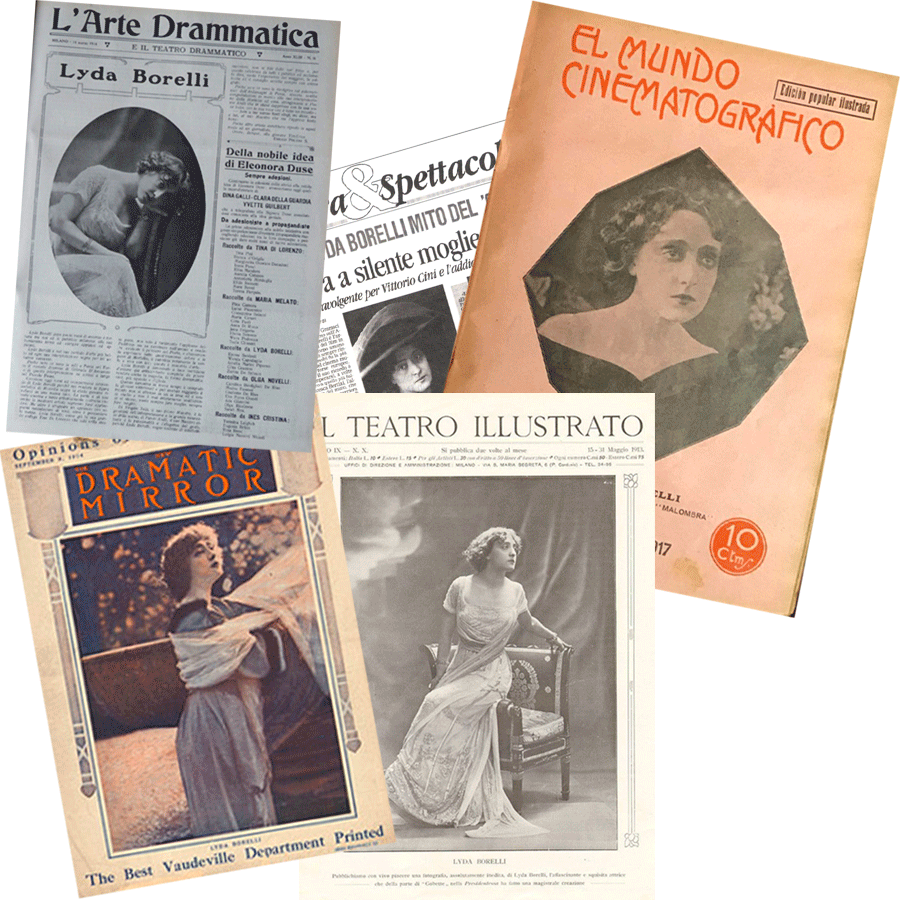
LYDA BORELLI: a modern iconA conversation with Maria Ida Biggi and Marianna Zannoni of the Istituto per il Teatro e il Melodramma, Fondazione Giorgio Cini, Venice.
MALOMBRA by Carmine Gallone
Italy, 1917, 75′The film Malombra by Carmine Gallone is accompanied by live music from pianist and composer Daniele Furlati.
-
Marina goes to live in the castle of her uncle, Count Cesare, but soon finds herself contending with the count’s late wife, by whom she becomes possessed. Marina struggles constantly with her double identity, swinging between spells of illness and madness. Despite her worsening paranoia, she falls in love with Corrado Silla, a writer of a gothic-tinged novel, who returns her feelings despite her strange behaviour.
Tickets 5 euros, available via Eventbrite or at Villa Pisani, Riviera G. B. Belzoni 22, Monselice (PD).
Daniele Furlati is a composer and pianist. In film he has co-written, with Marco Biscarini, the music for several award-winning features, among them Il vento fa il suo giro (2005), Best Original Score award at the Lagonegro Festival 2007, L’uomo che verrà (2009), Ennio Morricone Award at the Bari Film Festival 2010 and a David di Donatello 2010 nomination for Best Music, and Un giorno devi andare (2013), Ciak d’Oro 2013 nomination for Best Score.
In case of rain: Cinema Corallo, via S. Luigi 18, Monselice (PD)
- the 22nd edition of the Euganea Film Festival runs from 21 June to 2 July. Download the programme
Followed by
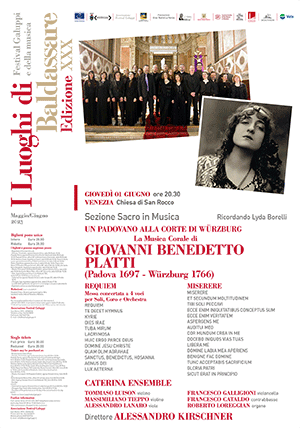 Festival Galuppi 2023
Venice, Chiesa di San Rocco
- Un padovano alla corte di Würzburg – CONCERT DEDICATED TO LYDA BORELLI
The choral music of Giovanni Benedetto Platti (Padua 1697 – Würzburg 1766), Thursday 1 June 2023
GIOVANNI BENEDETTO PLATTI (1697-1766)REQUIEM — Mass for 4 voices, soloists, choir and orchestra: Requiem, Te decet hymnus, Kyrie, Dies irae, Tuba mirum, Lacrymosa, Huic ergo parce Deus, Domine Jesu Christe, Quam olim Abrahae, Sanctus, Benedictus, Hosanna, Agnus Dei, Lux aeterna.
MISERERE — Miserere, Et secundum moltitudinem, Tibi soli peccavi, Ecce enim iniquitatibus conceptus sum, Ecce enim veritatem, Aspergens me, Auditui meo, Cor mundum crea in me, Docebo iniquos vias tuas, Libera me, Domine labia mea aperiens, Benigne fac Domine, Tunc acceptabis sacrificium, Gloria Patri, Sicut erat in principio.
GIOVANNI BENEDETTO PLATTI (1697-1766)CATERINA ENSEMBLE — Tommaso Luison violin, Massimiliano Tieppo violin, Alessandro Lanaro viola, Francesco Galligioni cello, Francesco Cataldo double bass, Roberto Loreggian organ.
Alessandro Kirschner, conductor: a choral conductor and composer, he trained in piano, choral music and choral conducting, and composition, later graduating in contemporary compositional disciplines. He is the permanent conductor of the Caterina Ensemble vocal group and works with the Cesare Pollini Conservatory’s Coro di voci bianche in Padua. As a choral conductor and composer he has won numerous national and international competition prizes. His music is performed by choirs around the world and published in Italy and abroad. He teaches at the Cesare Pollini Conservatory in Padua and is a lecturer in choral conducting technique at the ASAC Veneto’s Accademia “Righele”.
Founded in Padua in 2009, the Caterina Ensemble vocal group focuses mainly on repertoire up to the late Baroque. Made up of around twenty-five singers, the group has been directed since 2015 by Alessandro Kirschner.
The ensemble works with established musicians and musical organisations such as Roberto Loreggian, Giammichele Costantin, ConSerto Musico, the viola da gamba ensemble Le Viole di Orfeo, the Società Musicale directed by Carlos Gubert, and the Orchestra della Venezie directed by Giovanni Angeleri; as the resident training choir for the ASAC’s Accademia di direzione corale “Piergiorgio Righele”, it has worked with Marco Berrini, Luigi Marzola, Francesco Erle, Giovanni Acciai, Giulio Prandi and Lucio Golino.
The Caterina Ensemble has been invited to take part in major festivals in our region (Musica ed Antiche Chiese – Province of Padua, Musica per l’ora dell’Angelus – Padua, Bottega Tartiniana – Padua, the opening of the Festival Biblico 2017 and 2020 – Vicenza and Padua, Santa Maria Gloriosa dei Frari – Venice, Festival Galuppi, Venice) and has always stood out for the quality of its musical programme, much appreciated by audiences.

Press and news
- Giardino di Casa Lyda Borelli – Incontri nel giardino di Lyda Borelli 2023, 26 Agosto 2023 – 03 Settembre 2023, ore 20.30
- Monselice (PD) – Euganea Film Festival 2023 al via con un omaggio alla diva Lyda Borelli, Cafè24, 19 giugno 2023