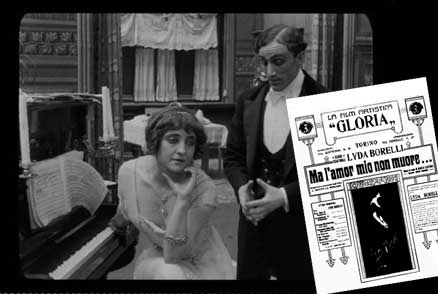
Ma l’amore mio non muore (1913)
- Director: Mario Caserini
Story: Emiliano Bonetti, Giovanni Monleone
Cinematography: Angelo Scalenghe
Production company: Gloria Film - Cast and characters
Lyda Borelli (Elsa Holbein) | Mario Bonnard (Prince Massimiliano) | Vittorio Rossi Pianelli (Colonel Julius Holbein) | Emilio Petacci (Colonel Theubner) | Camillo De Riso (Schaudard, the theatrical impresario) | Gian Paolo Rosmino (Moise Stahr) | Dante Cappelli (Grand Duke of Wallenstein) | Maria Caserini (Grand Duchess of Wallenstein) | Gentile Miotti (an officer) | Letizia Quaranta (a noblewoman) | Antonio Monti (a general) - Plot
In the Grand Duchy of Wallenstein lives the beautiful Elsa Holbein, daughter of the chief of staff, Colonel Julius Holbein, who takes his own life after being wrongly accused of treason, while the missing military plans have in fact been stolen by Moise Stahr. Elsa, innocent though she is, is exiled and takes refuge on the Riviera. There she takes to the stage as a singer and pianist under the name Diana Cadouleur and, thanks to an engagement from the impresario Schaudard, finds considerable success and regains her peace of mind.
At the height of her success, Elsa meets Prince Massimiliano, heir to the Grand Duke, who knows nothing of her true identity. The two fall in love, but during a boat trip on Lake Locarno they run into Stahr, who recognises the woman and, spurned by her, takes revenge by spreading news of the Prince’s affair, so that he is recalled home. Massimiliano, defying his father the Grand Duke’s orders, returns to look for Elsa, but by then she has poisoned herself. - information drawn from Wikipedia, the free encyclopedia (Italian).
1913 Ma l’amor mio non muore (b/w, silent – approx. 90 min.)
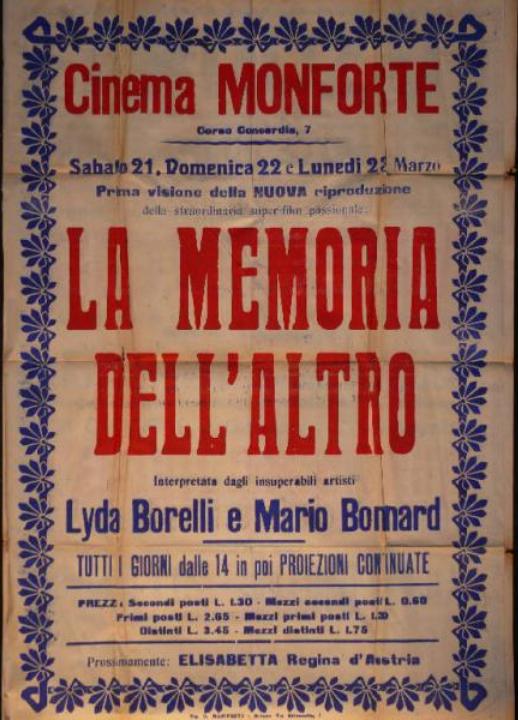
La memoria dell’altro (1913)
- Director: Alberto Degli Abbati
Story: Baroness De Rege
Cinematography: Angelo Scalenghe
Production company: Film Artistica “Gloria” - Cast and characters
Lyda Borelli (Lyda) | Mario Bonnard (Mario Alberti) | Vittorio Rossi Pianelli (Prince of Sévre) | Letizia Quaranta (Cesarina) | Felice Metellio (the journalist) | Emilio Petacci - Plot
Lyda, a young aviator, pays no heed to the constant courting of the Prince of Sévre and falls in love with a young journalist, Mario Alberti, whom she invites to her home. Although engaged to Cesarina, Mario accepts the invitation: his fiancée, struck by suspicion, follows him and, heartbroken, witnesses a love scene between him and Lyda. Taking advantage of a brief absence by her rival, Cesarina manages to persuade Mario to leave Lyda: now alone, Lyda accepts the love and the wealth of the Prince of Sévre.
Some time later, in Venice, Lyda and the Prince are inwardly divided by “the other’s memory”; and when Lyda sees Mario again at the theatre, their passion is rekindled and she runs away with her beloved to Paris. The two lovers are happy. But one day Mario falls ill and is confined to bed for months: the couple is soon reduced to poverty. Lyda goes looking for help and finds it only in the generosity of some apaches, for whom she dances in a tavern. But on returning home, she finds Mario dead. Distraught, and by now ill herself, Lyda fades away in the grim ward of a hospital. The Prince of Sévre, learning the sad news, hurries generously to her bedside. But by now Lyda needs nothing more. Sensing that all is over, she reaches nervously for the photograph of her beloved Mario, fallen at the foot of the bed, as her eyes close in the embrace of death. - On the wave of success from her first screen role in Ma l’amor mio non muore!, Lyda Borelli returned to work with Mario Bonnard and Vittorio Rossi Pianelli for La memoria dell’altro, playing the young aviator Lyda. Marked by beautiful Venetian exteriors, the film was a great success, helped also by the kind of woman Lyda Borelli portrayed, which matched the image the actress had built for herself. Critics of the day noted the connection between Lyda the aviator and Lyda Borelli the diva, suggesting that Baroness De Rege, who wrote the story, may have drawn on Borelli’s own image as an emancipated woman, passionate about flying and engines, but also a seductive dancer and femme fatale.
- The film was restored by the Fondazione Centro Sperimentale di Cinematografia in Rome, with the support of Lyda Borelli’s heirs, for the “Lyda Borelli – Diva Cinematografica” event held at the Ateneo Veneto on Friday 10 November 2017. The screening was accompanied by live music from Cinzia Gangarella and preceded by a talk with contributions from Maria Ida Biggi, Daniela Currò and Angela Dalle Vacche. Between October and November 2018 the film was also shown at the Pordenone Silent Film Festival (“Le Giornate del Cinema Muto”), in Paris, and at the 11th Festival de Cine y Música de San Isidro (Buenos Aires).
- information drawn from sempre in penombra | Fondazione Giorgio Cini, Venice | Enciclopedia del Cinema in Piemonte (Italian).
1913 – La memoria dell’altro (b/w, silent – 70 min.)
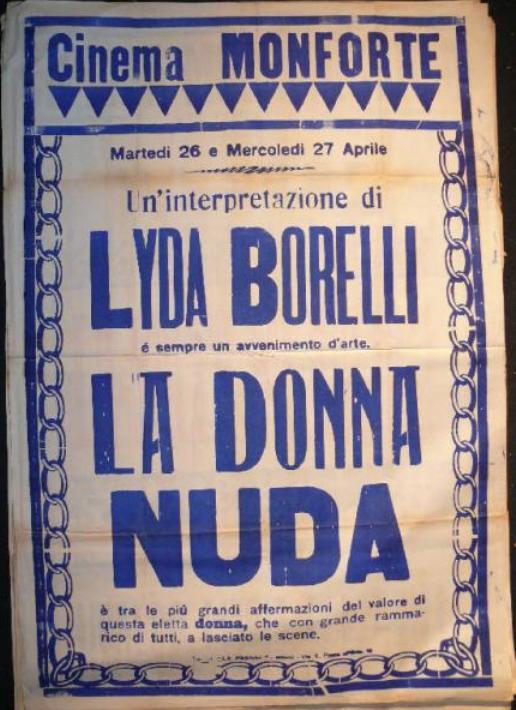
La donna nuda (1914)
- Director: Carmine Gallone
Story: Henry Bataille
Cinematography: Domenico Grimaldi
Production company: Cines - Cast and characters
Lyda Borelli (Lolette) | Lamberto Picasso (Pierre Bernier) | Wanda Capodaglio (the Princess) | Ugo Piperno (Rouchard) | Ruggero Capodaglio - Plot
A mediocre painter becomes famous thanks to the portrait of the model who becomes his wife.
Based on Henry Bataille’s play La femme nue - information drawn from sempre in penombra | Wikipedia, the free encyclopedia (Italian).
1914 La donna nuda (b/w, silent – approx. 60 min.)
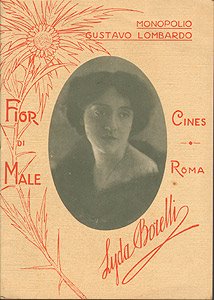
Fior di Male (1915)
- Director: Carmine Gallone
Story and screenplay: Nino Oxilia
Cinematography: Domenico Grimaldi
Production company: Cines - Cast and characters
Lyda Borelli (Lyda) | Augusto Poggioli (Bambi Rogers) | Cecyl Tryan (Cecyl) | Fulvia Perini (Fulvia Rogers) | Ruggero Barni (Ruggero Davusky) - Plot
Lyda has had a difficult childhood and adolescence, at the mercy of a harridan who exploited her, sending her onto the streets. Falling pregnant, she abandons her son and flees the police who are about to arrest her. Taken in by an elderly count, she finds honest work and wins the trust of her employers. Near death, the count adopts her, and on his death Lyda goes to live in the house that is now hers, together with Cecyl, an orphan she loves as a sister. Both girls fall in love with a young man they have saved from an accident, but Lyda steps back, letting Cecyl and the young man marry. One night a thief breaks into the house: from a scar, Lyda realises the young man is the son she abandoned. When the couple arrive, Lyda shields the thief, leading them to assume he is a casual lover of hers, so much so that the husband asks Lyda to leave the house. She wanders off in search of her son and, when she finds him, he stabs her, believing her to be a police informer. Dying, Lyda calls out her son’s name as he, arrested by the police, walks past her, unaware of who the woman is. - information drawn from sempre in penombra | Wikipedia, the free encyclopedia (Italian).
1915 Fior di male (b/w, silent – approx. 62 min.)
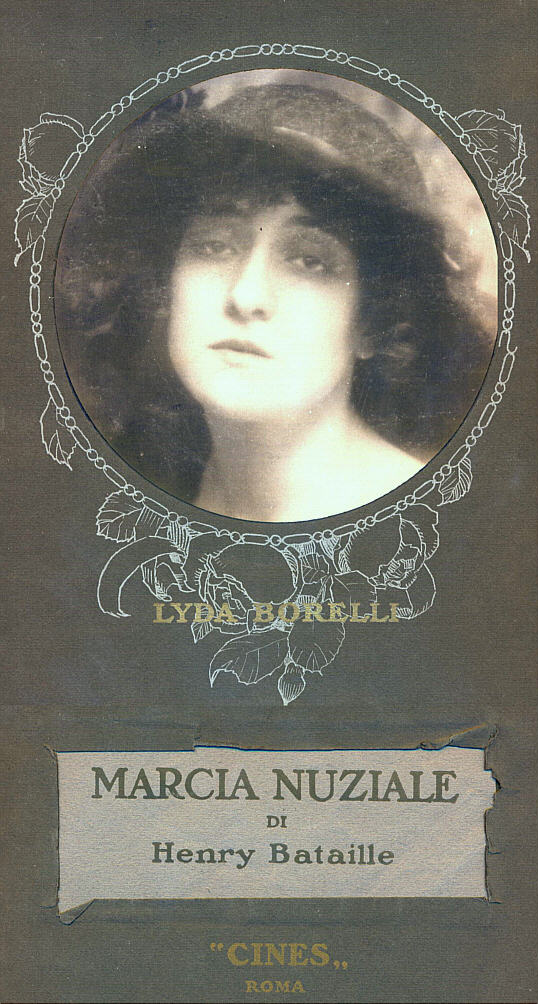
La marcia nuziale (1915)
- Director: Carmine Gallone
Story: Henry Bataille
Screenplay: Carmine Gallone, Henry Bataille
Cinematography: Domenico Grimaldi
Production company: Cines - Cast and characters
Lyda Borelli (Grazia di Plessans) | Francesco Cacace (Ruggero Lechatelier) | Leda Gys (Susanna Lechatelier) | Amleto Novelli (Claudio Morillot) | Wanda Capodaglio | Angelo Gallina - Plot
Grazia de Plessans leaves her convent studies after a mystical crisis. At her father’s house she studies music with the teacher Claudio Morillot, with whom she falls in love. The de Plessans family strongly opposes the match, so much so that the couple elopes. They live in poverty, helped by a friend of Grazia’s whose husband, the banker Lachatelier, gives the music teacher a job. But when Grazia asks Claudio for a piano to play at home, he steals money from Lachatelier. Grazia is horrified. She accepts an invitation to Susanna’s house and, for a moment, gives in to the banker’s advances, when he proposes that she run away with him. She decides to go back to Claudio, to make peace with him. One day, as he plays La marcia nuziale on the piano, a gunshot ends Grazia’s life: she has chosen to take it herself.
Based on Henry Bataille’s play La marche nuptiale (1905) - information drawn from Wikipedia, the free encyclopedia (Italian).
1915 La marcia nuziale (b/w, silent – approx. 60 min.)
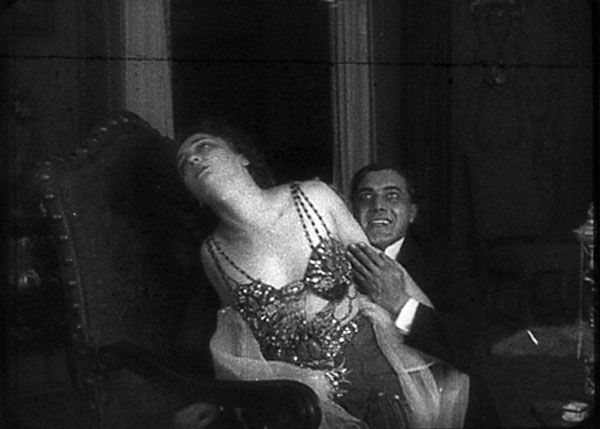
La Falena (1916)
- Director: Carmine Gallone
Story: Henry Bataille
Cinematography: Giovanni Grimaldi
Production company: Società Italiana Cines - Cast and characters
Lyda Borelli (Thea di Marlievo) | Andrea Habay (Filippo) | Francesco Cacace (Lignères) | Giulia Cassini-Rizzotto (Princess Maria) | Nella Montagna (Thea’s mother) | Lina Dax (Allegra) | Alfonso Cassini (Thea’s teacher) | - Plot
Thea, a sculptor diagnosed with consumption right before her wedding to Filippo, decides to leave him and live dissolutely until death. Yet, as her health rapidly declines, she throws one last party, inviting Filippo too. He does not show up, however, having married another woman. In one final, desperate, theatrical gesture, Thea shows herself naked to her guests, so they will remember the perfection of her body, and then takes her own life.
Based on Henry Bataille’s play Le phalène (1913) - information drawn from sempre in penombra | Wikipedia, the free encyclopedia (Italian).
1916 La Falena (b/w, silent – approx. 65 min.)
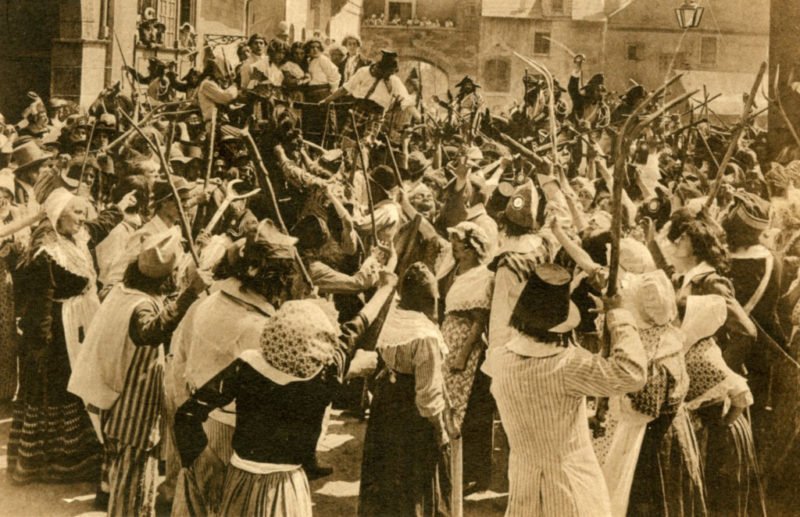
Madame Tallien (1916)
- Director: Enrico Guazzoni
Story: from the play of the same name by Victorien Sardou
Screenplay: Enrico Guazzoni
Cinematography: Gabriele Gabrielian
Production company: Palatino-Film - Cast and characters
Lyda Borelli (Madame Teresa Tallien) | Amleto Novelli (Tallien) | Renzo Fabiani (Robespierre) | Ruggero Barni (Guery) | Ettore Baccani (Fontenay) | Roberto Spiombi (a young cleric) | Orlando Ricci - Plot
The Marquise Teresa di Fontenay falls in love with Jean Guery, a young journalist; she divorces her elderly husband, Fontenay, and hopes to marry her beloved, but the outbreak of the Revolution prevents the wedding. Guery, a fervent monarchist, goes underground and, repeatedly risking his life, carries out daring actions against the revolutionaries. Caught in an ambush, he is arrested by the sans-culottes and brought to trial: it is the unbending Robespierre who presides over the proceedings. Teresa, with whom Tallien — a member of the Committee of Public Safety — has fallen in love, promises she will be his if he saves Guery. Tallien, in a memorable session of the Convention, violently attacks Robespierre, who is deposed and sent to the guillotine. But the wave of reaction turns against Tallien too, who falls from grace, and Guery is executed. Teresa is left alone.
Restored in 1995 by the Cineteca di Bologna, the Cineteca Italiana and the Cinémathèque française, with support from the Proyecto Lumière, from a camera negative on nitrate stock without intertitles, recovered by the Cineteca Italiana from the Pittaluga archive, and from a tinted and toned nitrate print with French intertitles held by the Cinémathèque française. The colours of the print were reproduced using the Desmet method - information drawn from Il cinema ritrovato | Wikipedia, the free encyclopedia (Italian).
1916 Madame Tallien (silent – 80 min. at 20 fps. Tinted and toned)
Malombra (1917)
- Director: Carmine Gallone
Story and screenplay: Antonio Fogazzaro
Cinematography: Giovanni Grimaldi
Production company: Cines - Cast and characters
Lyda Borelli (Marina Crusnelli di Malombra) | Amleto Novelli (Corrado Silla) | Augusto Mastripietri (Count Cesare d’Ormengo) | Amedeo Ciaffi (Andrea Steinegge) | Giulia Cassini Rizzotto (Countess Fosca Salvador) | Consuelo Spada (Edith Steinegge) | Francesco Cacace (Nepo Salvador) | Noemi De Ferrari | Berta Nelson | Giorgio Fini - Plot
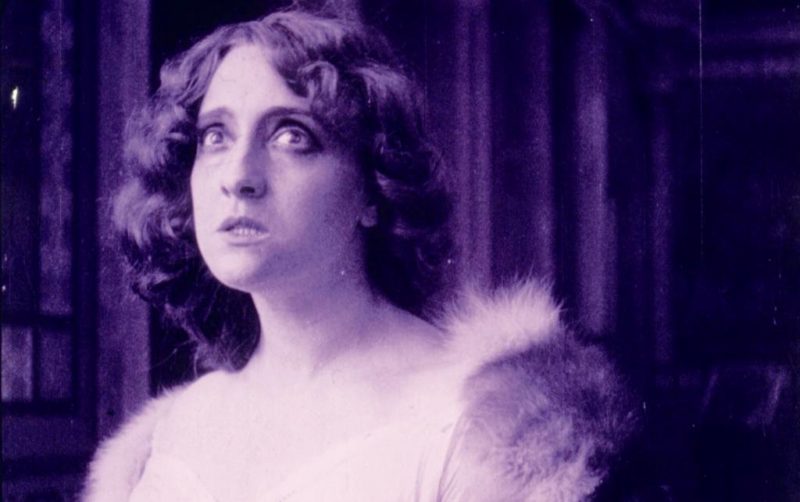
Marina di Malombra is a woman confined to a villa on Lake Como, until the day of her wedding.
The film, one of Lyda Borelli’s most significant roles, launched the gothic genre in Italian cinema.
Malombra glows with a sumptuous visual style and immerses the audience in the spell of enchanted landscapes, a sinister romantic castle and the spectacular performance of the diva Borelli. Possessed by inner demons, Borelli draws out her glances and gestures to great effect, or reclines in a boat among cushions and flowers, a languid victim and fatal Lorelei, her body wrapped in a luminous aura. The first reel closes with one of the most striking scenes of the entire diva-film genre: Marina di Malombra/Lyda Borelli lets down her hair, gives in to her madness (or is it Cecilia’s spirit?), her face lost among the waves of her hair as her wild gaze transforms her into a Maenad, before she finally faints and falls to the ground.
The plot unfolds so loosely that viewers who have not read, or do not remember, Antonio Fogazzaro’s gothic novel of the same name (1881) have no way of knowing exactly who is who, how each character relates to the others, or why everyone does what they do. Moreover, today’s audiences can easily miss the clues offered by certain aspects of the staging, such as costume. When Marina arrives at the castle dressed and veiled in black, her mourning attire signals the reason for her arrival: she has just been orphaned and has come to live with her uncle. Later, another mourning dress tells the audience that the count has died, following Marina’s nocturnal attack. - information drawn from Il cinema ritrovato | Wikipedia, the free encyclopedia (Italian).
1917 Malombra (b/w, silent – approx. 75 min.)
La storia dei tredici (1917)
- Director: Carmine Gallone
Story: Honoré de Balzac
Screenplay: Lucio D’Ambra
Cinematography: Giovanni Grimaldi
Production company: Cines - Cast
Lyda Borelli | Ugo Piperno | Sandro Salvini - Plot
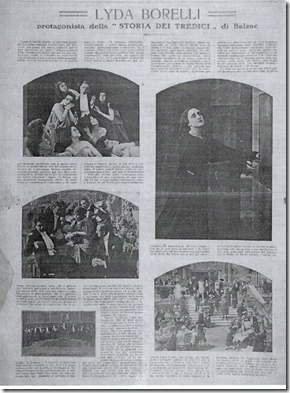
Based on Honoré de Balzac’s Histoire des treize, a novel published between 1833 and 1839, in which the author formally introduces a group of friends of different social backgrounds, distinguished by differing political ideals, worldviews and goals, yet bound together by an unwritten pact of mutual aid.
The lives of these characters unfold across many other books that make up the Comédie humaine, where they take part in events or simply appear in those scenes of social life that Balzac so loved to describe.
The thirteen characters appear in Balzac’s fiction as very young people of modest means, in search of the fulfilment of their own ideals and desires. Across the various books some reach their goals, others perish, but the trust and the bond that unites them never wavers, filling Balzac’s books with episodes of great devotion and courage. - information drawn from Cinematografo | Balzac in Italia (Italian).
1917 La storia dei tredici (b/w, silent – approx. 60 min.)
Rapsodia satanica (1917)
- Director: Nino Oxilia
Story: Fausto Maria Martini, Alberto Fassini
Screenplay: Alberto Fassini
Music composed by: Pietro Mascagni
Set design: Giorgio Ricci
Production company: Cines - Cast and characters
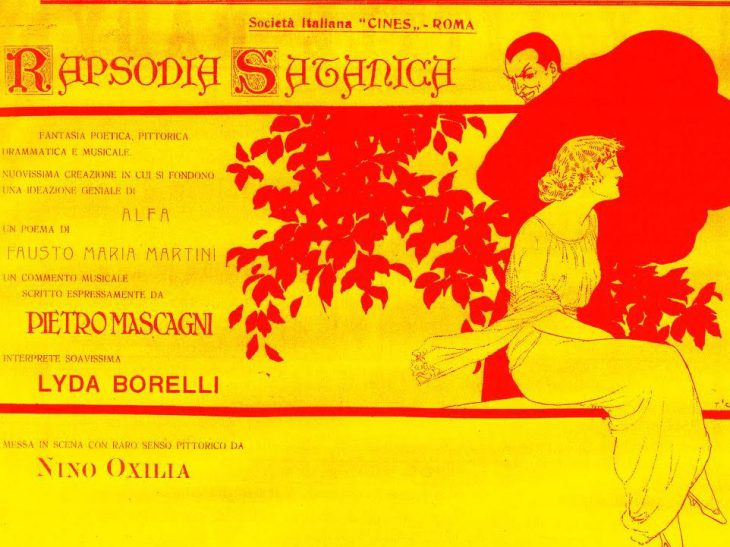
Lyda Borelli (Alba d’Oltrevita) | Andrea Habay (Tristano) | Ugo Bazzini (Mephisto) | Giovanni Cini (Sergio) | Alberto Nepoti - Plot
The story is a variation on the Faust legend, drawn from a 1915 poem by Fausto Maria Martini. Alba d’Oltrevita, an elderly society lady, strikes a pact with Mephisto to regain her youth, on condition that she never fall in love. Alba is courted by two young brothers, Tristano and Sergio. Sergio threatens to kill himself if she will not love him: she pays him no attention, however, and he takes his own life, while she prepares to marry Tristano. At this point Mephisto returns to reclaim the youth he had granted her, restoring old age to Alba, who has broken the pact.
One of the most important silent films of its generation, both for its D’Annunzian inspiration — reflected in its subject and in a set design of decadent nobility strongly steeped in Liberty-style aesthetics — and for the performance of Lyda Borelli, star of Italian silent cinema. The score is by Pietro Mascagni, one of the leading composers of the day and the first professional composer in Italy to score a film, synchronising his music to the film’s scenes (work he described as “long, arduous and extremely difficult”).
For the centenary of the silent-cinema epic Cabiria, Rapsodia satanica was also screened at the Auditorium Rai in Turin, with Pietro Mascagni’s score performed by the RAI National Symphony Orchestra (21 June 2014). - information drawn from Il cinema ritrovato | Wikipedia, the free encyclopedia (Italian).
1917 Rapsodia satanica (hand-tinted b/w, silent – 55 min. original – 45 min. restored)
Carnevalesca (1918)
- Director: Amleto Palermi
Story and screenplay: Lucio D’Ambra
Cinematography: Giovanni Grimaldi
Production company: Cines - Cast
Lyda Borelli | Mimi | Livio Pavanelli | Renato Visca | Gino Cucchetti - Plot
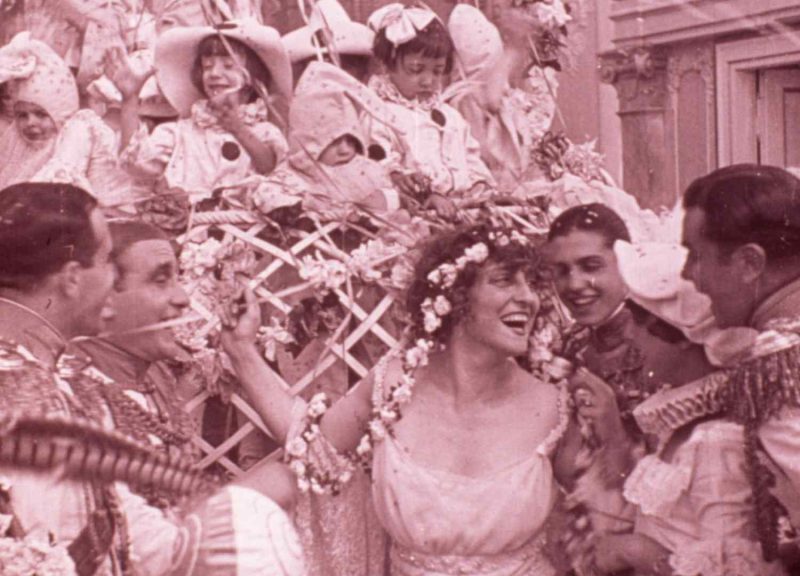
«This bouquet of four carnivals unfolds in the castle of Malesia. The white carnival shows the young children of a sovereign and their little cousins enjoying festive, fanciful games. The years pass. Luciano, heir to the crown, falls in love with Lyda. And this is the blue carnival. But when he realises an attempt is being made to tear Lyda from his affections, he gives up the throne and runs away with her. The prince’s flight fuels the ambitions of the cousins who aspire to the sceptre: they will destroy one another. And this is the red carnival. Among the aspirants is Carlo, who believes himself the chosen one, but, fearing the old king may change his mind and recall the rightful heir, sets a trap for Luciano and stabs him in the back. And this is the black carnival.» (from the original brochure for the film)
It has been judged an irritating film: too deeply sunk in the coils of an aesthetic lingering in a nineteenth-century Byzantium. Seen today, however, from a historiographical perspective no longer bound to the neorealist quest for a holy grail, it appears instead as a splendid cinematic poem, dense with surprising suggestions. In short, Carnevalesca deserves to be seen again from the opposite point of view. It is not a rearguard work, but part of “our” avant-garde: that of Italian silent cinema. Lyda Borelli’s performance helps burn its images into the memory.
The film was restored by the Cineteca di Bologna in 1993 from a print found in Montevideo. - information drawn from sempre in penombra | Cineteca di Bologna (Italian).
1918 Carnevalesca (b/w, silent – 87 min.)
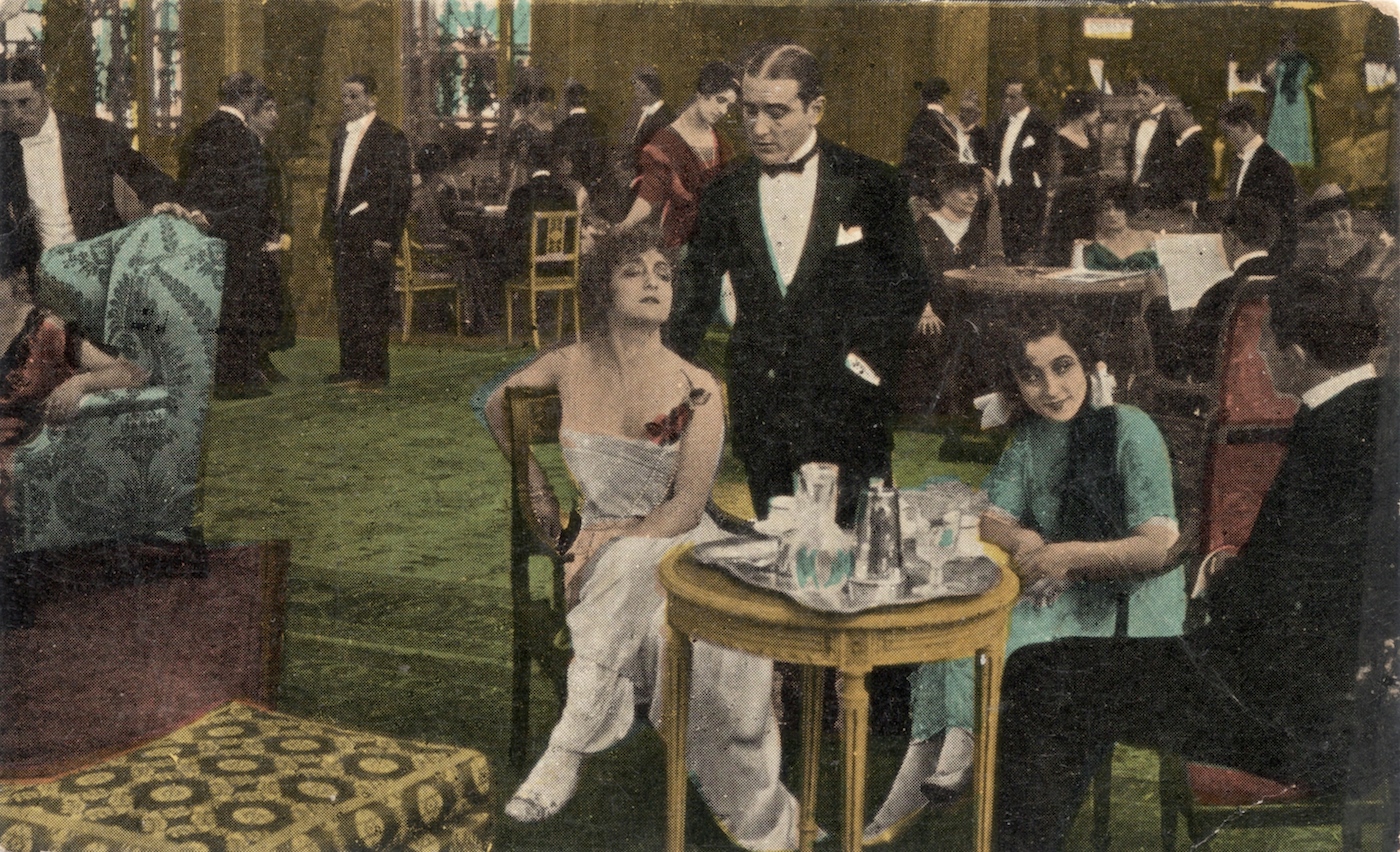
Dramma di una notte (1918)
- (also known as Una notte a Calcutta)
Director: Mario Caserini
Cinematography: Giovanni Grimaldi
Production company: Cines - Cast and characters
Lyda Borelli (Nelly) | Alberto Capozzi (Guido De Mauri) | Livio Pavanelli (Riccardo De Mauri) | Anna Rocchi (Daisy) - Plot
The story of Guido (Alberto Capozzi), a naval officer who returns to Italy to meet his brother’s future wife, and recognises in her Nelly, a “woman of easy virtue” with whom he had a relationship in a house of pleasure in India. At the time, Nelly was caring for her mother and her younger sister Daisy (Anna Rocchi). After her mother’s death, Nelly repents, returns to Italy and learns to love sincerely: Riccardo (Livio Pavanelli). Nelly begs Guido not to tell his brother, but in the end agrees to leave without a trace. Left alone, she takes her own life, scratching herself with nail varnish laced with poison. This was Lyda Borelli’s final film before she married Count Vittorio Cini and withdrew from public life, both on stage and on screen.
Dramma di una notte is a lost film. - information drawn from Flickr – Il Dramma di una notte | Il cinema ritrovato (Italian).
1918 Dramma di una notte (b/w, silent – 11′ at 18 fps.)
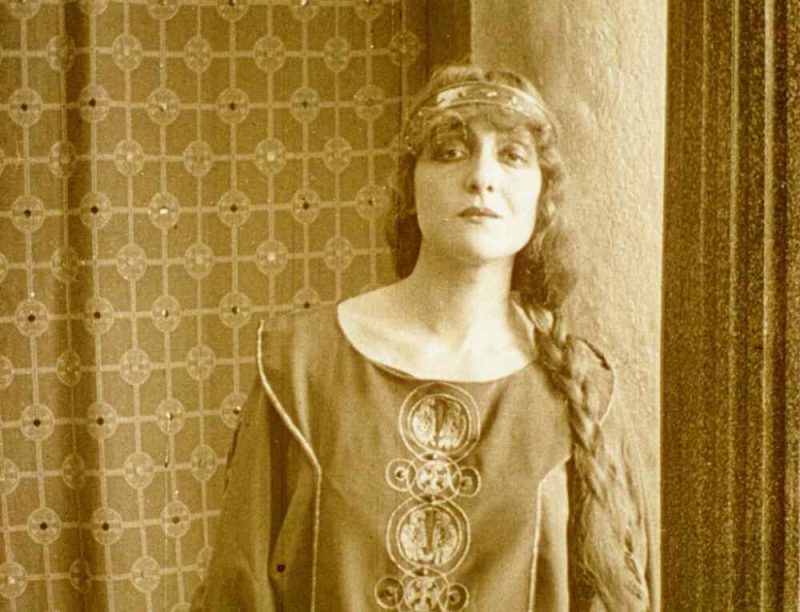
L’altro esercito (1918)
- (also known as La leggenda di Santa Barbara)
Cinematography: Giulio Rufini)
Production company: Cines, on behalf of the Ministry of War - Cast and characters:
Lyda Borelli (Saint Barbara) - A feature-length film commissioned by the Ministry of Arms and Munitions. Made to showcase the organisation and successes of Italy’s military production, it drew even on the participation of the great silent-film diva Lyda Borelli to boost its propaganda impact.
The film was divided into two parts: Le armi (“Weapons”), illustrating the working of cast iron and steel and the manufacture of cannons, bombs and explosives, rifles, machine guns and barbed wire, and Le munizioni (“Munitions”), devoted to publicising the workers’ schools for children, women and those unfit for the hardships of war, and to describing the manufacture of shells, torpedoes, and transport and assault vehicles, among other things. Between the two parts was inserted an interlude recounting the sacrifice of Barbara, a fourth-century Christian martyr, played by the diva Lyda Borelli. - information drawn from Il cinema ritrovato | Daniela Felisini, Il triangolo del fuoco. Parlamento, pubblica amministrazione e imprese nell’esperienza della mobilitazione industriale, pp. 203-220 of “Parlamenti di Guerra (1914-1945)” (Italian)
1918 L’altro esercito (colour feature – silent – 16 min.)
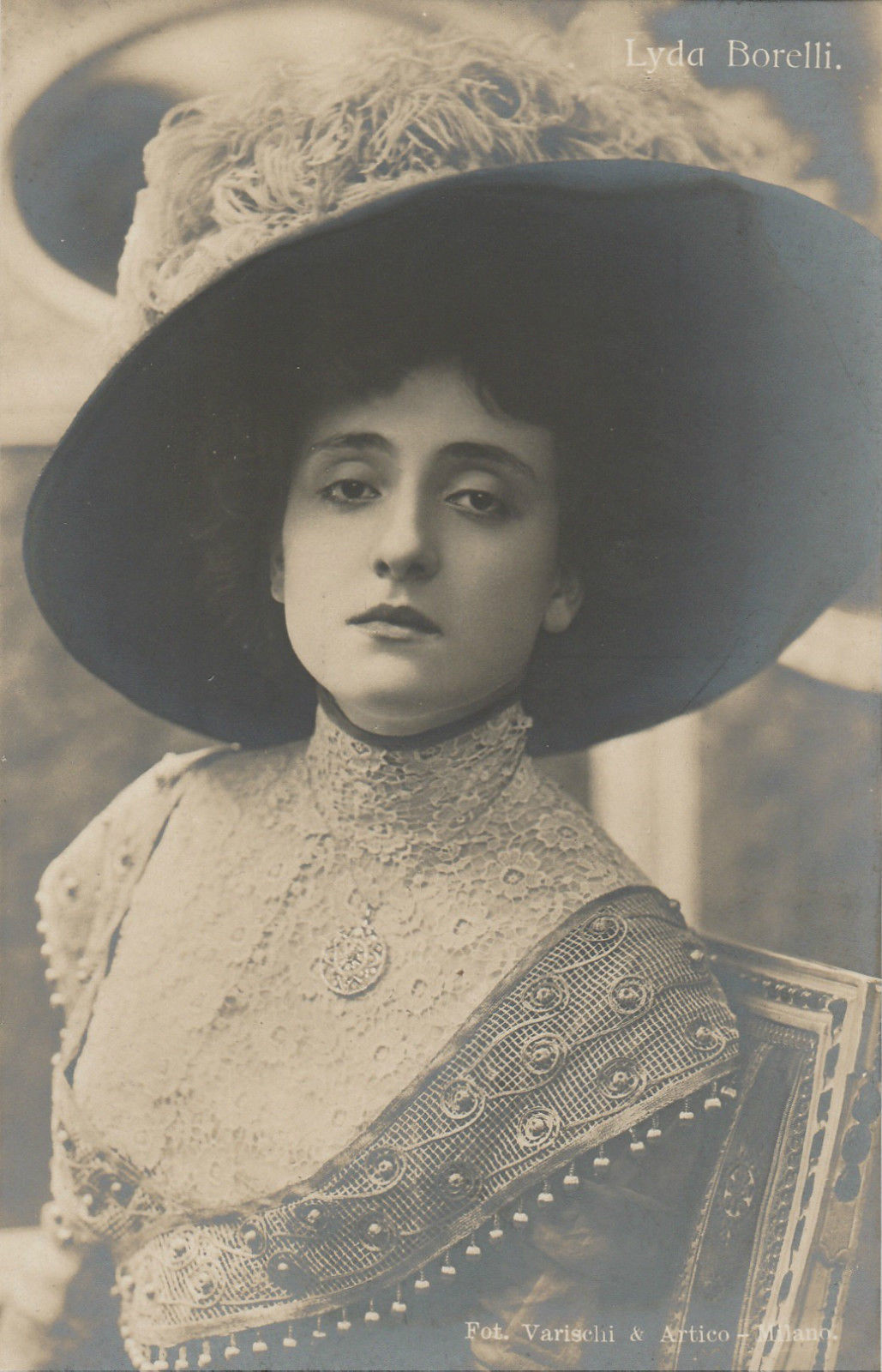
Lyda Borelli
- Production company: Cines
- Cast
Lyda Borelli - A wartime propaganda documentary.
1918 Per la vittoria e per la pace! (lost documentary, b/w)
…
There are also a few titles that “borrowed” footage from Lyda Borelli’s films as a tribute to, and a record of, the silent-film era
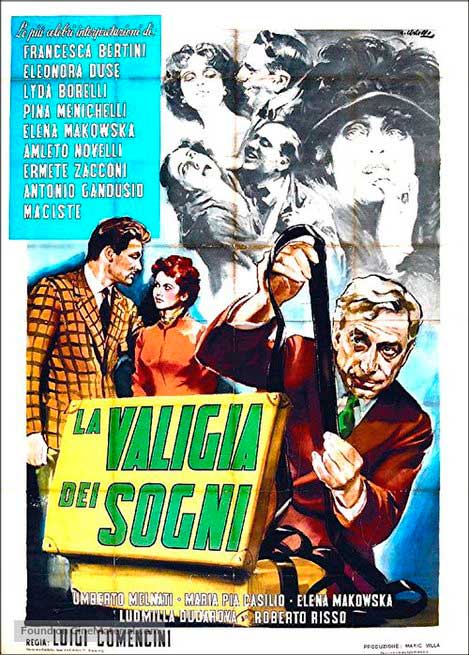
La valigia dei sogni (1953)
- Director: Luigi Comencini
Story and screenplay: Ettore Maria Margadonna, Luigi Comencini, Giuseppe Bennati
Cinematography: Vaclav Vich
Editing: Franco Fraticelli
Music: Mario Nascimbene
Set design: Flavio Mogherini
Production company: Mambretti Film - Cast and characters
Marcello Mastroianni | Umberto Melnati (Cavalier Ettore Omeri) | Maria Pia Casilio (Mariannina) Lyda Borelli (Herself – archive clips) | other silent-film actors (Wanda Capodaglio, Lamberto Picasso, Ermete Zacconi, Francesca Bertini, Eleonora Duse …) (Themselves – archive clips)| - La valigia dei sogni (“The suitcase of dreams”), whose closing scenes show old films being burned in Cavalier Omeri’s cellar, gives voice to the anguish of those who worked to save films from destruction. In those years, film stock was made of flammable nitrate, and safety film on an acetate base did not yet exist. Aside from the risk of fire, there was also the danger that within a few years the chemical breakdown of the material would run its course. The efforts of the “pioneers” of the early film archives therefore had a single goal: to save, at any cost, the films that represented the historical memory of the twentieth century. With La valigia dei sogni, the need to preserve the moving image, in the same way the written word is preserved, was perhaps for the first time put to the public with such urgency and passion — and the film’s appeal is certainly as relevant as ever today.
The film tells two real stories: the first concerns a certain Mario Ferrari, a real person (who, until his death in 1938, collected films for his own private archive); the second is that of Comencini himself, who together with his younger brother and Alberto Lattuada founded the Cineteca di Milano, one of the first film archives in the world.
The film was made for the Cineteca Italiana, which was in financial difficulty at the time, on a very small budget: both Comencini and the cast waived their fees. The film was not, however, a success. - information drawn from FilmTv | Wikipedia, the free encyclopedia (Italian).
1953 La valigia dei sogni (b/w comedy – 87 min.)

Diva Dolorosa (1999)
- Director: Peter Delpeut
Screenplay: Peter Delpeut
Editing: Menno Boerema
Music: Loek Dikker
Production: FilmMuseum and Vpro Television, in collaboration with the Cineteca del Comune di Bologna – Producer: Frank Roumen - Cast and characters
Lyda Borelli (Herself – archive clips) | Francesca Bertini (Herself – archive clips) | other silent-film actresses (Soava Gallone, Pina Menichelli, Elena Makawska) (Themselves – archive clips)| - The film uses fragments of period films to build a portrait of the divas of Italian silent cinema, in support of the following idea: these actresses played their roles as a spectacle of the body, for which they paid with hysteria for their success and their daring. Many Italian films between 1913 and 1930 starred idols of popular cinema who embodied the sexually liberated woman elevated to a muse by Decadentism. In the eyes of the ordinary viewer of the day, however, in keeping with the spirit of the times, their passion could not go unpunished and had to be paid for with a toll of suffering, which is what made these divas “dolorosa” — sorrowful.
The film was screened at the Venice Film Festival (New Territories section) in 1999 - information drawn from ComingSoon | RdC – cinematografo.it (Italian).
1999 Diva Dolorosa(silent film compilation – 70 min.)
Linked videos are ones available on YouTube; where no video link is given, the link instead goes to a page dedicated to the film