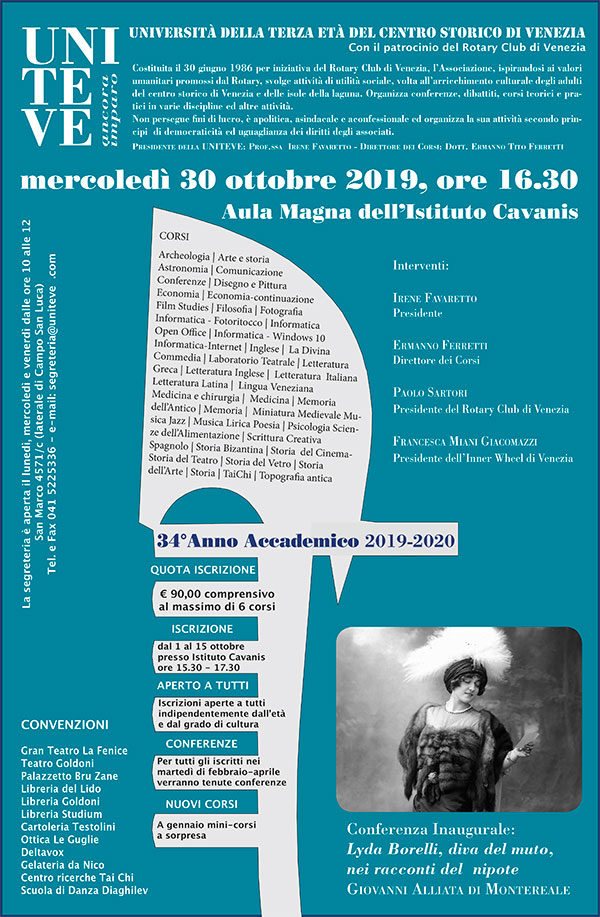
Opening of the 34th academic year of the University of the Third Age
Venice, Istituto Cavanis
Talk on Lyda Borelli, silent-film diva, 30 October 2019, 4.30pm
For the opening of the 34th academic year of the University of the Third Age, a talk by Giovanni Alliata di Montereale, Lyda Borelli, diva cinematografica del cinema muto.
The event includes screenings of clips from the great actress’s films, together with images portraying her in family and professional life.
SPEAKERS
Irene Favaretto, President, UNITEVE
Ermanno Ferretti, Director of Courses
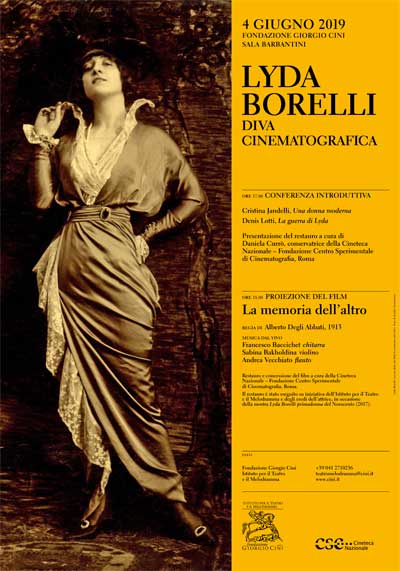
To mark sixty years since the death of Lyda Borelli, who died on 2 June 1959, and as part of the events dedicated to rediscovering her as an artist, the Istituto per il Teatro e il Melodramma organises the day Lyda Borelli diva cinematografica: an event devoted to the cinema of the great actress, a leading lady of national and international stages who, in the 1910s, became a true star of the big screen.
At 6.00pm the film La memoria dell’altro is screened, directed by Alberto Degli Abbati in 1913 and restored in 2017 by the Cineteca Nazionale – Fondazione Centro Sperimentale di Cinematografia in Rome. In the film, shot amid beautiful Venetian exteriors, Lyda Borelli plays the aviator Lyda, an emancipated woman with a passion for flying and engines. The screening is accompanied by live music performed by Francesco Baccichet (guitar), Sabina Bakholdina (violin) and Andrea Vecchiato (flute).
5.00pm | INTRODUCTORY TALK
Cristina Jandelli, Una donna moderna
Denis Lotti, La guerra di Lyda
Presentation of the restoration by
Daniela Currò, curator at the Cineteca
Nazionale – Fondazione Centro Sperimentale
di Cinematografia, Rome
Daniela Currò, our excellent speaker at this talk, photographed in Cannes behind Lina Wertmüller (later an honorary Oscar recipient), Giancarlo Giannini and Leonardo Di Caprio
6.00pm | FILM SCREENING
La memoria dell’altro
DIRECTED BY Alberto Degli Abbati, 1913
LIVE MUSIC
Francesco Baccichet guitar
Sabina Bakholdina violin
Andrea Vecchiato flute
Restoration and film courtesy of the Cineteca
Nazionale – Fondazione Centro Sperimentale di Cinematografia, Rome.
The restoration was carried out on the initiative of the Istituto per il Teatro
e il Melodramma and the actress’s heirs, on the occasion
of the exhibition Lyda Borelli primadonna del Novecento (2017).
Edizioni Curci srl
critical revision by Marcello Panni
Screening of Nino Oxilia’s 1917 silent film, restored by the Cineteca di Bologna, with original music by Pietro Mascagni performed live.
Conductor, Valerio Galli
The Teatro Carlo Felice in Genoa turned a setback into an opportunity: forced, it seems for copyright reasons, to cancel the planned musical Sunset Boulevard by Andrew Lloyd Webber, it put together instead an evening of real charm with the unusual double bill Rapsodia satanica – Gianni Schicchi, music by Pietro Mascagni and Giacomo Puccini respectively — a blend of early cinema and opera, or rather comic opera.
The first half of the evening offers the restored version of Rapsodia satanica, a 1917 silent film produced by the Cinés company in Rome, directed in a symbolist, decadent style by Nino Oxilia, with Lyda Borelli in the lead role of Alba d’Oltrevita. Seen in the context of when it was made, over a century ago, it remains, all things considered, an enjoyable and not unappealing watch, allowances made for some naïveté and for an acting style far removed from today’s taste and sensibility. What lends it further charm is the music by Pietro Mascagni, a forerunner of the modern film composer. The informative programme notes by Massimo Pastorelli offer an interesting account of how Mascagni worked to move from composing for the theatre — where the composer has full control over timing and the calibration of effects — to composing for film, where the music instead has to bend to the length of the frames, the actors’ expressions and the projector’s speed. Mascagni did not shy away from the challenge, however, and rose to it with considerable skill, showing a real facility for adapting to this seventh art and seizing its opportunities. He also managed to remain true to himself, so that the melody and colour that emerge from the score are unmistakably his own.
The score, as at the film’s original premiere, is performed “live” during the screening, with the orchestra placed firmly in the pit. And it is precisely Valerio Galli’s conducting that is the strongest asset of this Genoa production. Galli believes in this music, is enthusiastic about it, and passes that enthusiasm on to the audience. He is always searching for the right timbre, judging the intensity of the sound with real precision, giving it a role always equal in importance to what is shown on screen. In this he is well supported by the excellent playing of the Genoa orchestra. […] ( Mauro Tortarolo, Connessi all’Opera, Lirica e dintorni ai tempi del 2.0)
The final act of “Adriana Lecouvreur” at the Verona Opera, with Lyda Borelli on the backdrop of the set.
“Adriana Lecouvreur is a stage actress at the height of her career, celebrated and adored by her admirers. Her private life plays out between theatres and noble households, between performances and declamations. It seems clear that, in shaping the character of Adriana, one must bear in mind the great divas active at the time the opera was composed. Their magic was born in the theatre, but for some it would reach its peak with the appearance of the new art form, cinema. Into this tenth muse, which had to reckon with the nine that came before it, flowed all the theatrical, literary and musical experience of the age, and, naturally, its actresses along with it. Adriana is an actress descended from the line of Sarah Bernhardt. In the classical theatre, new names were emerging: Eleonora Duse, Gys Leda, Francesca Bertini and Lyda Borelli. I find that Adriana resembles these “humble handmaidens” far more than the women who actually lived in the 1700s. And it is above all to the beguiling figure of Lyda Borelli, who made her stage debut in 1902 in the very role of Adriana Lecouvreur, that the director refers: “Lyda Borelli was the first great priestess of the emerging cult of the diva. Her soft, Pre-Raphaelite beauty, her D’Annunzian femme-fatale poses, her acting made of sweeping gestures, sudden languor and troubled glances, became the model for an entire generation of actresses, and went on to shape fashion until they became a true cultural phenomenon…” (Ivan Stefanutti)
The Ferrara Film Festival is one of the fastest-growing film festivals in the world, hosted in the Italian city of Ferrara, a UNESCO World Heritage site, which serves as an extraordinary backdrop for this high-profile cinema event. It is a global film competition, closing with the Golden Dragon Awards ceremony, and also features collateral film events, entertainment shows and an exclusive partnership with UNICEF. The Ferrara Film Festival is a cultural and economic bridge between the United States and Italy, being the first film festival on Italian soil organised directly from Los Angeles, where its headquarters are based. This, together with the Hollywood business experience of its organisers, makes the event innovative and unique of its kind.
The Ferrara Film Festival draws on prestigious partners such as the Comune di Ferrara, ASCOM, UNICEF Italia, the US Embassy in Italy and many others. Another key element tied to the city of Ferrara is its partnership with Giovanni e Vittorio Alliata di Montereale and the Archivio Vittorio Cini.
The award for Best Leading Actress (named after Lyda Borelli) in the “Feature USA” and “Feature World” categories went to Marie Leuenberger (Contro l’ordine divino)
Lyda Borelli, the first great diva of Italian silent cinema (along with other actresses of the period), is featured in a video produced by the Fondazione Cineteca di Bologna and shown in a small room of the museum, alongside small bronzes personifying women’s emotions.

 Opening of the 34th academic year of the University of the Third Age
 Lyda Borelli diva cinematografica
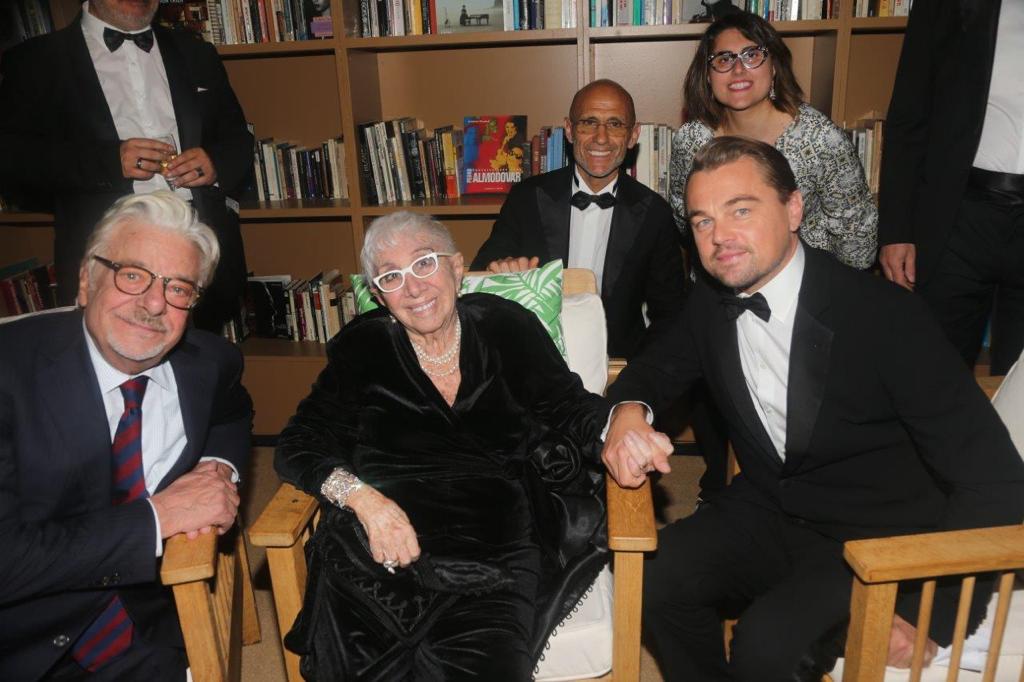 Daniela Currò, our excellent speaker at this talk, photographed in Cannes behind Lina Wertmüller (later an honorary Oscar recipient), Giancarlo Giannini and Leonardo Di Caprio
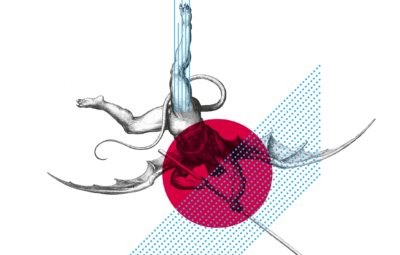 Rapsodia Satanica
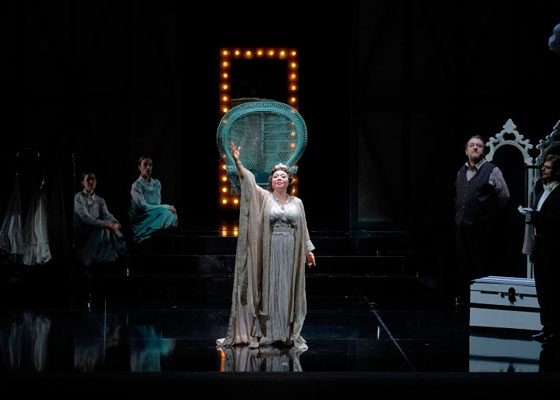 Adriana Lecouvreur
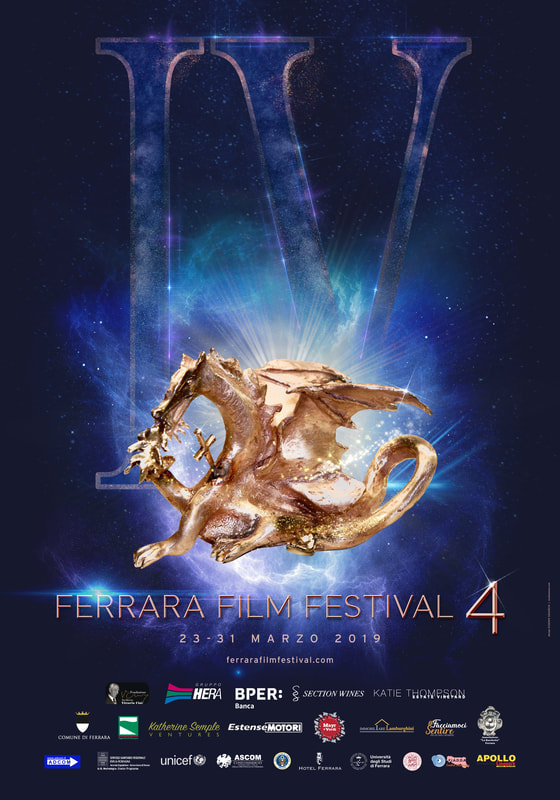 Ferrara Film Festival 2019
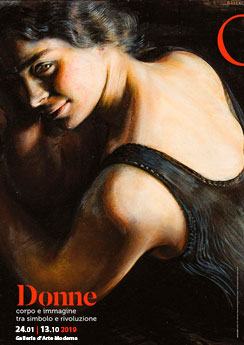 Poster for "Donne. Corpo e immagine tra simbolo e rivoluzione" (2019)