Photographs
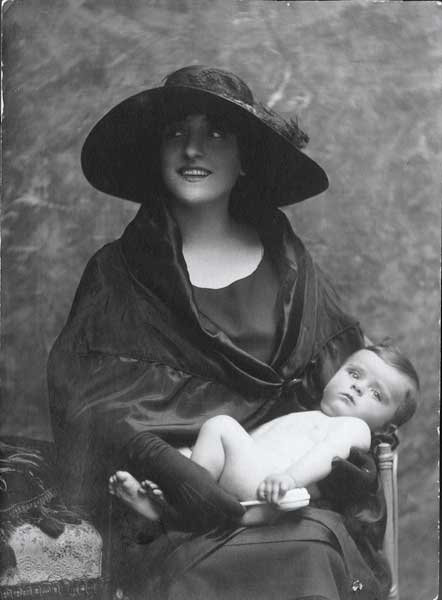
Lyda with Giorgio Cini
The exact date of her birth remained uncertain for a long time. From her birth certificate, preserved in the archive of her husband Vittorio Cini, we now know that Lyda was born on 22 March 1887 in La Spezia. Her parents were Napoleone Borelli and Cesira Banti, both actors originally from Reggio Emilia; she had a sister, Ada, who was also an actress. After spending her childhood at a religious boarding school in Florence, she made her debut in 1901 with the company directed by F. Pasta, alongside Virginia Reiter. Her delicate sensitivity first came through in the Italian premiere of A. Capus’s La fortuna, in which Borelli played the flower-girl Carlotta, redeeming the conventionality of the part with the warmth she was able to convey. In 1904 V. Talli opened the doors of his own company to her, the finest of the period. Alongside Irma Gramatica, Ruggero Ruggeri and O. Calabresi, Borelli played Favetta in the first performance of Gabriele D’Annunzio’s La figlia di Iorio (Teatro Lirico, Milan, 2 March 1904): her simple, clear style gave the shy, dreamy Favetta an unmistakable presence. Talli was Borelli’s mentor and tireless champion; having become a leading young actress, she starred alongside Duse, Talli and Ruggeri in Florence on 1 October 1905, in an extraordinary performance of V. Sardou’s Fernanda.
Borelli stayed with Talli even after the company’s leading members went their separate ways, and with Edvige Reinach as leading lady she also tried her hand at comic roles. Ruggeri took her on in March 1909; by now able to impose a style of her own, Borelli began to blend her natural gifts with the more pronounced mannerisms of the alluring, refined Liberty-style woman — sumptuously draped, sinuous in her movements: a foretaste of the poses she would later strike on screen.
In 1912 F. Andò engaged her for his company, and Borelli joined forces with U. Piperno and A. Gandusio. She found herself at ease in the Parisian repertoire, in the smooth, conventional society comedies typical of boulevard taste, such as C. M. Hennequin and P. Veber’s La presidentessa, which opened at the Teatro Sannazaro in Naples on 21 February 1913 and was a great success thanks to Borelli’s delightful characterisation, and R. de Flers, G. A. de Caillavet and E. Rey’s La bella avventura. On 27 January 1914, at the Teatro Valle in Rome, alongside Ugo Piperno, she played Vera Grossi in the premiere of D’Annunzio’s Il ferro, staged simultaneously in three cities. On 10 February 1915 she was the Marchesa di Montefranco in R. Bracco’s Maternità. On 19 February she took the role of Rosina in P. Ferrari’s comedy Goldoni e le sue sedici commedie nuove at the Teatro Dal Verme in Milan, in a performance meant as E. Novelli’s farewell to the stage, for which even minor parts were filled by celebrated actors. She then joined the Fert company directed by Novelli and took on an eclectic repertoire, ranging from Benelli’s tragedy and Bracco’s early society comedy to the raciest pochades; a notable experience, for the aestheticising atmosphere she brought to the leading role, was Oscar Wilde’s Salomè, performed alongside Novelli. On 17 April 1915 she played Stefania in Benelli’s Le nozze dei centauri, premiered at the Teatro Carignano in Turin; the drama, staged a month after Italy entered the war, owed its success not only to Borelli’s ardent performance but also to the nationalistic spirit that pervaded it. In 1917 she returned to work with Piperno for one last great achievement, in H. Bernstein’s L’elevazione.
From 1913 to 1918 Borelli was an acclaimed star of silent cinema. She was first invited by director Mario Caserini to play Elsa Holbein in Ma l’amor mio non muore, alongside Mario Bonnard. After that first film, she played Mortella in A. Degli Abbati’s La memoria dell’altro, again with Bonnard; in 1914, alongside Piperno, she played Stefania in La donna nuda, which Carmine Gallone adapted from H. Bataille; in 1915, paired with André Habay, she was Alba d’Oltrevita, a role created for her, in N. Oxilia’s Rapsodia satanica; then, alongside A. Novelli, Grazia di Plessans in Marcia nuziale, which Gallone drew from the play of the same name by Bataille. In 1916, with Bonnard again as her co-star, she played Miss Salomè in another Gallone adaptation from Bataille, La falena; this was followed by her portrayal of the tormented Marina, alongside Novelli, in Gallone’s Malombra, from A. Fogazzaro. That of the exuberant Jeanne-Marie, again alongside Novelli, in Caserini and E. Guazzoni’s Madame Tallien, closed the run of her great successes. From then on her films aimed increasingly at a mass audience, sinking into dark plots modelled on the earlier ones, with the same cast, down to La leggenda di Santa Barbara, a propaganda film commissioned by the Ministry of Arms and Munitions, which marked the end of Borelli’s film career in early 1918.
Borelli translated the sudden turns of dialogue — reduced to spare intertitles — into studied, plastic poses, and underscored its pauses with slow, measured gestures. Her style of acting stood in contrast to the harsh, spontaneous manner of Francesca Bertini: a floral pose set against a veristic one, giving rise, through film criticism, to the label “fatale” as opposed to the “diva” coined for Bertini. “Borellismo” became a cultural phenomenon, meaning the imitation of the “fatale” both on screen and in life, and it came to an almost sudden end when Borelli withdrew into private life.
In 1918, in Gavorrano (Grosseto), Borelli married the industrialist Count Vittorio Cini of Ferrara, retiring from both theatre and cinema. Averse to public life and devoted to charitable works, after the loss of her son Giorgio (1949) Borelli withdrew increasingly into solitude at the Palazzo Cini, formerly Palazzo Loredan, in Venice.
She died in Rome on 2 June 1959.
excerpt from “BORELLI, Lyda”, Dizionario Biografico degli Italiani – Volume 12 (1971), by Sisto Sallusti
Sources and bibliography: Comune di La Spezia, Stato civile; F. M. Martini, in La Gazzetta di Torino, 12-13 giugno 1918; A. Cervi, Senza maschera…, Bologna 1919, pp. 1-4; S. D’Amico, Tramonto del grande attore, Milano 1929, pp. 31, 136; R. Simoni, Trent’anni di cronaca dramm., I, Torino 1951, pp. 181-187; F. Montesanti, La parab. della “Diva”, in Bianco e nero, XIII (1952), n. 7-8, pp. 61-65; L. Ridenti, Ritratti perduti, Milano 1960, pp. 293-295; S. D’Amico, Cronache del teatro, I, Bari 1963, pp. 38, 41-42, 628; Id., in Encicl. Ital., VII, Roma 1930, p. 467, sub voce; N. Leonelli, Attori tragici-Attori comici, I, Milano 1940, pp. 165 s., sub voce; A. Casella-M. A. Prolo, in Encicl. dello Spettac., II, Roma 1954, coll.829 ss.,sub voce;R. Chiti, in Filmlexicon degli autori e delle opere, I, Roma 1958, coll.784 ss., sub voce.
Other biographies available online
(the information sometimes varies from source to source)
From the Enciclopedia Italiana (1930) by Silvio D’Amico
From the Enciclopedia del Cinema (2003) by Margherita Pelaja
From Wikipedia