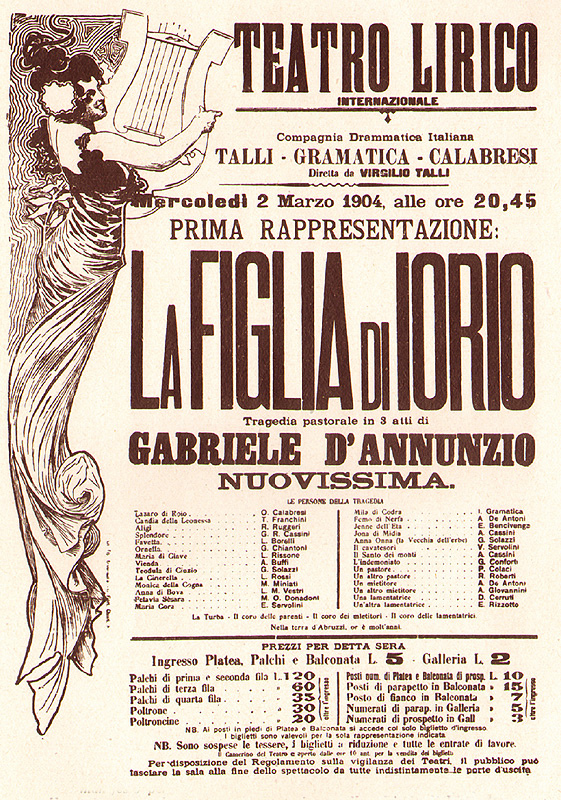
Poster for “La figlia di Iorio”, 2 March 1904, Teatro Lirico, Milan
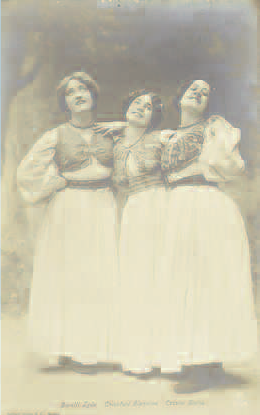
Lyda Borelli (Favetta), Giannina Chiantoni (Ornella), Giulia Cassini (Splendore) in “La figlia di Iorio”, photo by Varischi
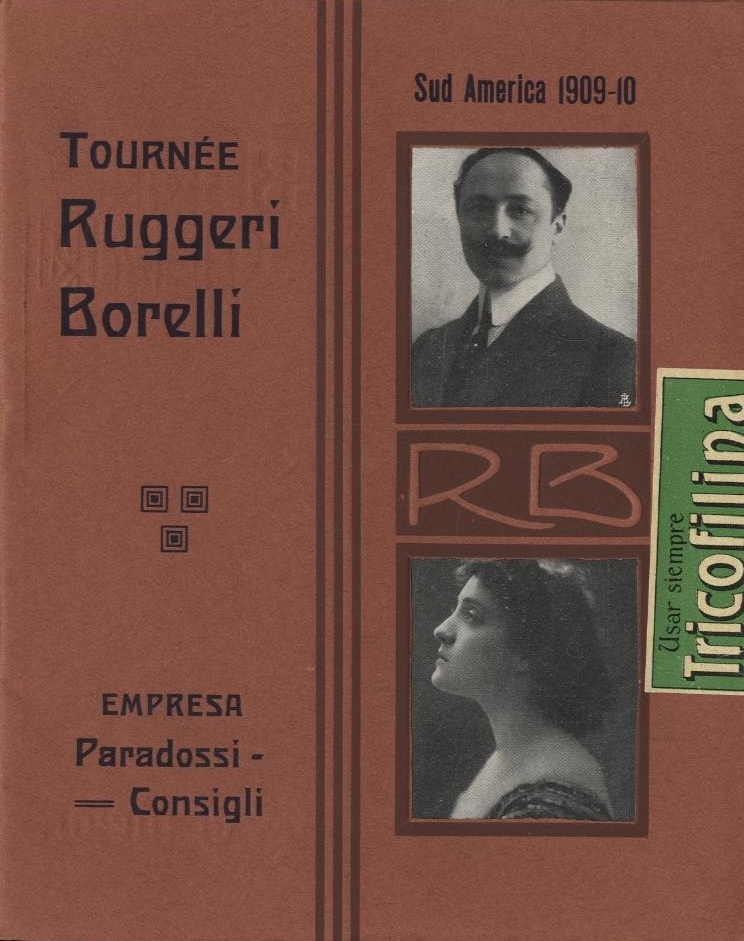
The Ruggeri-Borelli company on tour in South America, 1909-1910
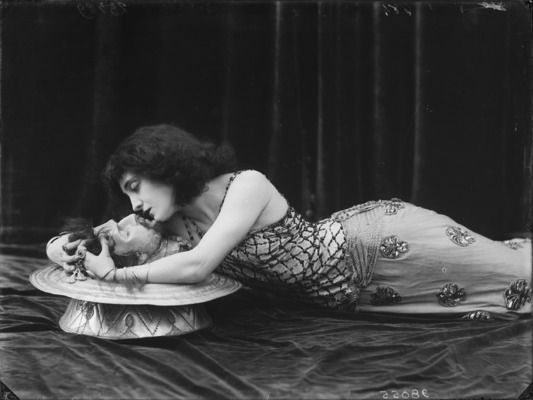
Lyda Borelli in costume as Salomé (1905-1910), portrait by Mario Nunes Vais
Both of Lyda Borelli’s parents were actors, so from a very young age she watched the leading ladies of the late-nineteenth-century dramatic theatre at work, sometimes from the wings, sometimes taking small parts herself.
“As a child she performed a small part in Mariani’s comedy Il passaggio di Venere and later in I due derelitti, alongside Paolina Pezzaglia, and then Mercedes Brignone” (Cervi, 1919); after completing her education at boarding school in Florence, she returned to the stage in 1902 with Francesco Pasta and Virginia Reiter’s company, performing in La veine, a comedy by Alfred Capus.
In 1903 she was engaged by the legendary Talli-Gramatica-Calabresi company, and in 1904 she played Favetta, one of Aligi’s three sisters, in the premiere of Gabriele D’Annunzio’s La figlia di Iorio — a part that let her stand out in one of the most important theatrical events of the century and quickly earned her promotion to leading young actress. In 1905 she played Fernanda in Victorien Sardou’s play of the same name, alongside Eleonora Duse, Virgilio Talli and Ruggero Ruggeri.
In 1909 she became head of her own company; alongside Ruggero Ruggeri, she triumphed, winning great popularity with a broad repertoire that included, among other productions, a staging of Oscar Wilde’s Salomé. The company kept up a frenetic pace of activity. In 1909 Borelli set sail on a tour of South America. In February 1912, after the company’s final Milan season, Ruggeri-Borelli disbanded and the actress formed a new company with Ugo Piperno and Antonio Gandusio, under the direction of Flavio Andò; the repertoire was almost entirely comic, and Borelli mostly took on light, brilliant roles. In 1915 she joined the Fert company directed by Ermete Novelli, in a wide-ranging repertoire that included stylised tragedies, drawing-room dramas, comedies and pochades. From 1916 until her retirement from the stage in 1918, she resumed her partnership with Ugo Piperno, founding the Borelli-Piperno company.
At the height of her success on stage, revered by audiences and admired by critics, Lyda Borelli made her triumphant entrance into cinema: Ma l’amor mio non muore, as noted elsewhere on this site, is literally the first “diva film” of Italian cinema. Her film and stage careers ran side by side until 1918, and many of the plays in Borelli’s stage repertoire were also brought to the screen, among them La donna nuda (Gallone, 1914), La marcia nuziale (Gallone, 1915) and Madame Tallien (Guazzoni, 1916).
excerpt from “K. Paronitti, Lyda Borelli, divina incantatrice
in Le incantatrici, Elephant & Castle 2013″
- On the theatre, around the web
- La compagnia Borelli-Piperno-Gandusio | Ruggero Ruggeri e Lyda Borelli | Lyda sul Palcoscenico | L’arte scenica di Lyda Borelli | L’enigma di Lyda Borelli (pages in Italian)