Lyda Borelli
Adriana Lecouvreur – photo by Marcello Orselli
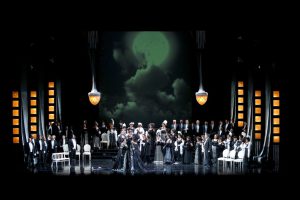 Adriana Lecouvreur – photo by Marcello Orselli
Genoa, Teatro Carlo Felice
- Adriana Lecouvreur, 12-16 February 2020
- Adriana Lecouvreur |
Francesco Cilea
Casa Musicale Sonzogno edition,
by Piero Ostali – Milan
Conductor, Valerio Galli
Direction, sets and costumes, Ivan Stefanutti
Assistant director, Filippo Tadolini
Choreography, Michele Cosentino
Lighting, Paolo Mazzon
Cast: Barbara Frittoli, Amarilli Nizza and Valentina Boi (Adriana); Marcelo Álvarez, Fabio Armiliato and Gianluca Terranova (Maurizio di Sassonia); Judit Kutasi and Giuseppina Piunti (Princess of Bouillon); Devid Cecconi and Alberto Mastromarino (Michonnet); Federico Benetti (Prince of Bouillon); Didier Pieri (Abbé de Chazeuil).
Production by the Associazione Lirica Concertistica Italiana (As.Li.Co.)
Orchestra and Chorus of the Teatro Carlo Felice
Chorus master, Francesco Aliberti
- Adriana Lecouvreur was a celebrated actress in early-eighteenth-century Paris. She was the toast of the capital’s stages, performing the works of Racine and Voltaire. Her beauty and talent captivated men, and legend has it that she died poisoned by a rival in love. A character born to become literature: indeed, Eugène Scribe and Ernest Legouvé made her the protagonist of a stage drama, one that won over the “gentle” verismo of Francesco Cilea: “the variety of the plot”, the composer said of the subject, “which offered me fresh, elegant situations, the blending of comedy and drama within an eighteenth-century setting that I knew well, and the passionate love of the protagonist, touched my heart and fired my imagination.” Its premiere, in 1902 at the Teatro Lirico in Milan (with Enrico Caruso in the cast), was a great success.
Ivan Stefanutti, who directs this Associazione Lirica Concertistica Italiana (As.Li.Co.) production and also designed its sets and costumes, moves the opera from the early 1700s to the period in which it was composed: a fin de siècle setting in which Adriana’s diva-like quality stands out, taking on the poses typical of the great actresses of the early twentieth century — an Adriana as silent-film star, so to speak, of the very kind that was emerging just as Cilea was working on the opera. “Adriana,” the director explains, “is an actress descended from the line of Sarah Bernhardt. In the classical theatre, new names were emerging: Eleonora Duse, Gys Leda, Francesca Bertini and Lyda Borelli.” And indeed it was Lyda Borelli who made her stage debut in 1902 as “Adriana Lecouvreur”, and who would later link her name to music by starring in Oxilia’s film “Rapsodia satanica”, for which Pietro Mascagni wrote the score.
“I find that Adriana resembles these ‘humble handmaidens’ far more than the women who actually lived in the 1700s.“
-
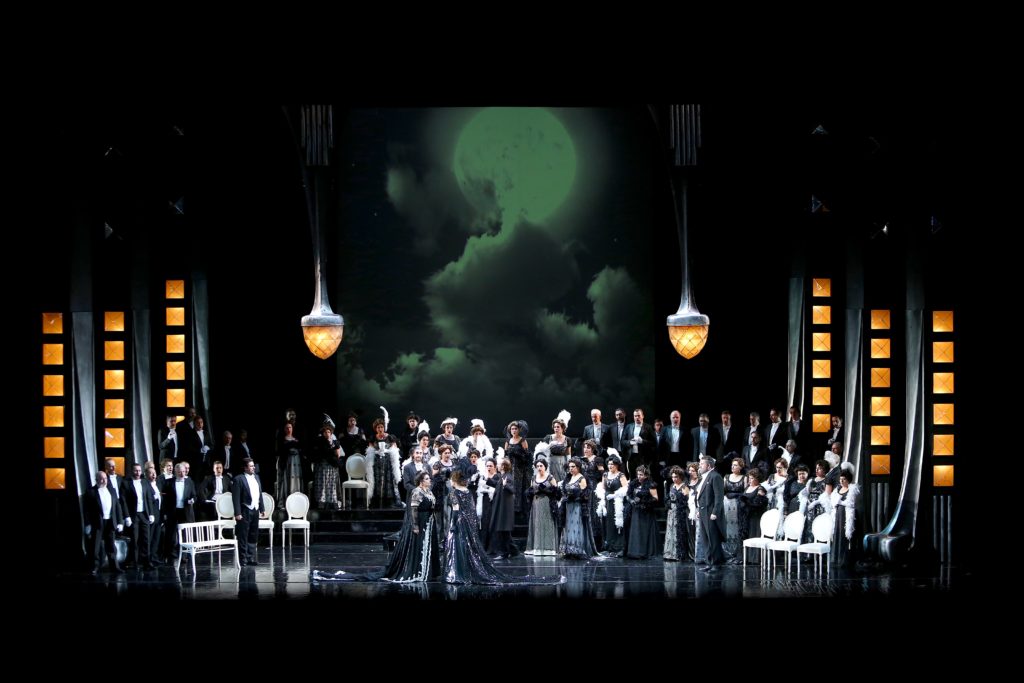 Adriana Lecouvreur – photo by Marcello Orselli